GEMSTONEWELL
Amethyst Birthstone: February's Stone, Its Meaning and How to Wear It
Amethyst is February's birthstone. Learn what it means in crystal traditions, how people wear and use it, how to care for it and how to spot a fake.
 By Gemstone Well
Published
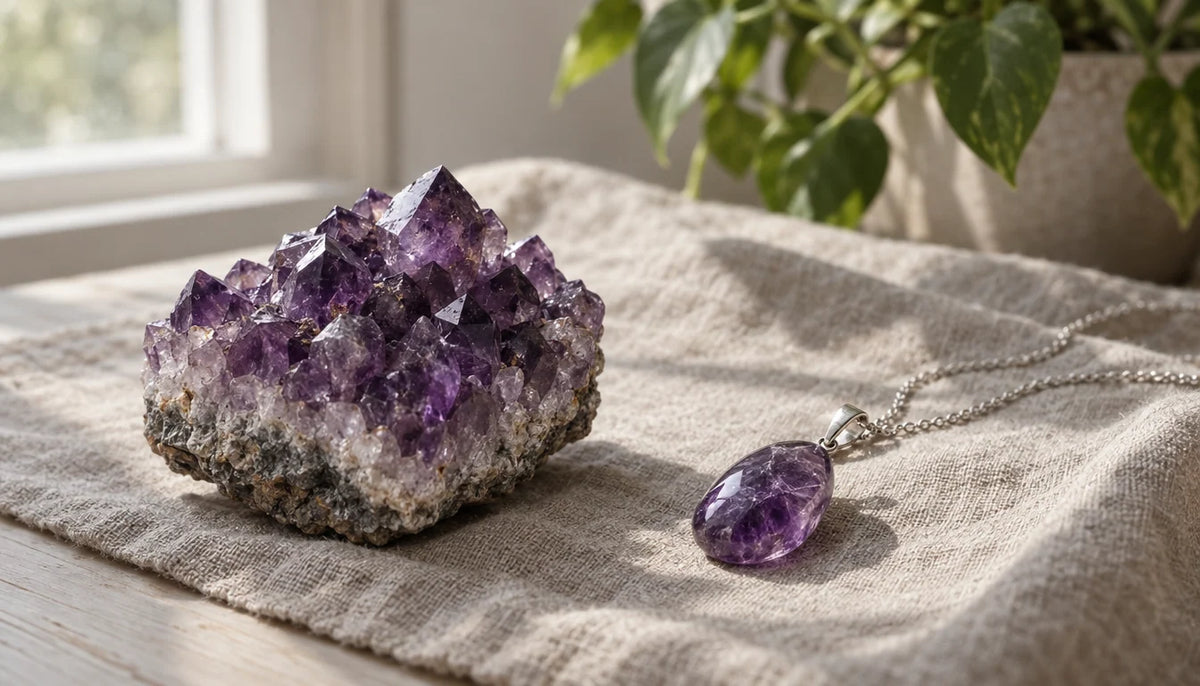
The amethyst birthstone belongs to February, and in crystal traditions it stands for calm, clear thinking and self-control. People wear it as jewelry, keep a piece at home, hold it while they meditate or keep it close in a crystal water bottle.
Maybe you're shopping for someone born in February and want the gift to mean something. Here's the short story. Amethyst is purple quartz, colored by a little iron and natural radiation deep in the ground. Its history goes back to the ancient Greeks. It needs a few simple care rules, and once you know what to look for, fakes get easier to spot.
Is amethyst really the February birthstone?
Yes. Amethyst was February's stone on the very first modern US birthstone list, adopted in August 1912. The National Association of Jewelers, now called Jewelers of America, put that list together (Wikipedia's birthstone history covers the details).
The list has changed several times since. Alexandrite, citrine and pink tourmaline joined in 1952, tanzanite in 2002 and spinel in 2016. Amethyst kept its place through every update. GIA also names it the gem for the 6th and 17th wedding anniversaries.
Here are all 12 months, based on GemSelect's month-by-month chart.
| Month | Birthstone | How people often use it |
|---|---|---|
| January | Garnet | Rings and pendants in deep red |
| February | Amethyst | Jewelry, home decor, meditation |
| March | Aquamarine, bloodstone | Light blue jewelry; carved stones |
| April | Diamond | Engagement and anniversary rings |
| May | Emerald | Statement rings and earrings |
| June | Pearl, moonstone, alexandrite | Necklaces and gentle everyday pieces |
| July | Ruby | Rings and gifts for big moments |
| August | Peridot, spinel | Bright green or colorful jewelry |
| September | Sapphire | Rings that stand up to daily wear |
| October | Opal, tourmaline | Pendants and colorful collections |
| November | Topaz, citrine | Warm yellow and orange jewelry |
| December | Turquoise, tanzanite, zircon | Blue pieces and silver settings |
February's zodiac signs are Aquarius and Pisces. Astrology is a belief tradition, and nothing says any sign "can't" wear amethyst.
What is amethyst, and how does it get its purple color?
Amethyst is the purple variety of quartz, a very common mineral made of silicon and oxygen. Pure quartz is colorless. According to the Smithsonian's amethyst entry, the purple comes from a few iron atoms sitting where silicon would normally be.
It happens in two steps. Traces of iron get into the crystal as it grows. Then gamma rays act on that iron and turn it purple. Gamma rays are a natural radiation given off by radioactive rock nearby.
The color runs from pale lilac to deep royal purple, often in uneven bands of lighter and darker color. Those bands are called color zoning. They form because the crystal took in different amounts of iron as it grew.
Here's the catch: heat can take the purple away, or turn amethyst yellow or orange. That's worth knowing when you shop.
Where does the name amethyst come from?
The name comes from the Greek word amethystos, meaning "not intoxicated," according to Britannica's amethyst entry. An old belief said the stone kept its owner from getting drunk. It's a legend, not a fact, but it lasted for centuries.
Amethyst shows up in the Bible too, as one of the 12 stones on the high priest's breastplate in Exodus. And there's a sweet February link: tradition says St. Valentine wore an amethyst ring carved with an image of Cupid.
So why is such a storied stone so affordable now? GIA notes that amethyst once cost as much as ruby and emerald. Then huge deposits were found in Brazil in the 1800s, and prices dropped.
What does amethyst mean in crystal traditions?
In crystal traditions, amethyst means peace, calm and self-control. Some sources add serenity and royalty, and link the stone with courage and stronger relationships. Many people also treat it as a symbol of protection and balance.
These are old themes, not proven effects. Research hasn't shown that crystals have health effects, so take any health question to a doctor.
That doesn't make the stone any less special. For a lot of people, a purple stone on a desk is simply a reminder to slow down and breathe.
How do people use amethyst day to day?

Jewelry is the most common use, and amethyst holds up well. It rates 7 on the Mohs scale, the 1-to-10 scale of how well a stone resists scratches, according to GIA's amethyst gemstone page. It also has no cleavage, meaning no weak lines it can split along. That makes it tough enough for rings, bracelets, earrings and pendants.
A few simple ways people enjoy it:
- Pendants and earrings, which get knocked around less than a ring worn every day.
- Lighter-colored stones in pieces worn now and then, since pale amethyst fades more easily.
- A stone on a desk or bedside table, away from bright windows.
- Holding a stone during meditation, as something to focus on.
- Keeping one close as part of a daily water habit.
Think of meditating with amethyst as a ritual you enjoy, not a treatment. A small habit you keep beats an elaborate one you skip.
How do you care for amethyst?

Sun fades it. Jewelers Mutual warns that long hours of direct sunlight can lighten amethyst, especially paler stones, so take your jewelry off before a long day at the beach or pool.
Cleaning is easy:
- Soak the stone for 10 to 15 minutes in lukewarm water with a drop or two of mild dish soap.
- Scrub gently with a soft toothbrush or cloth.
- Rinse well.
- Pat dry.
Skip ultrasonic and steam cleaners. Amethyst also dislikes high heat and sudden temperature changes, and it's best kept away from harsh chemicals, perfume and chlorine.
Store it in a soft pouch or a lined box, apart from harder stones like diamond and sapphire that can scratch it.
How can you spot a fake amethyst?
There are three kinds of amethyst on the market. Natural amethyst formed in the ground over a very long time. Heat-treated amethyst started out natural and was heated to change its color. Lab-grown amethyst is made by people. It's still real amethyst, just not natural.
Heat makes things confusing. Much of the "citrine" for sale is really heated amethyst, and heat can also turn it pale green, a quartz called prasiolite. So a color name on its own doesn't tell you what a stone started as.
Lab-grown amethyst can look almost identical to natural stone inside. Because amethyst is inexpensive, the jewelry trade magazine JCK suggests choosing stones with inclusions, the small natural flaws inside a crystal.
When you shop:
- Perfectly even color with no zoning is worth a question.
- Glass can pass for amethyst, so ask what the stone actually is.
- A seller who names the origin and any treatment is a good sign.
The most useful question is a simple one: what does the seller call it?
Where Gemstone Well fits
Gemstone Well option: the Crystal Water Bottle Elixir Set in Amethyst & Clear Quartz, for someone who wants a small amethyst ritual built into their day.
The stones sit in a separate chamber, so they never touch the water. That's the indirect method. It matters because some minerals should never sit in drinking water: malachite can release copper, pyrite can rust and selenite dissolves. Keeping the stone near your water but never in it is the safe way to pair the two.
The bottle doesn't do anything to the water. It simply keeps the stone with you through the day. For more on what the stone means, see Gemstone Well's page on amethyst meaning.
The Bottom Line
Amethyst has been the February birthstone since the first US list in 1912. It's purple quartz, colored by iron and natural radiation, and in crystal traditions it stands for calm, clarity and self-control. Keep it out of long, strong sun, clean it gently, and when you buy, ask the seller how the stone was made.
FAQ
What month is amethyst the birthstone for? February. It has held that spot on the US list since 1912, and it's also the gem for the 6th and 17th wedding anniversaries.
Can amethyst go in water? A short soak in soapy, lukewarm water is fine for cleaning. Near drinking water, the indirect method keeps the stone in a separate chamber, away from what you drink.
Does amethyst fade in the sun? Yes, over time. Lighter stones fade fastest, so keep them away from sunny windows.
How can you tell real amethyst from fake? Look for natural inclusions and some color zoning, and ask the seller to name the origin and any heat treatment or lab growth.
Which zodiac signs go with amethyst? Aquarius and Pisces, since both fall in February. Astrology is a belief tradition, so anyone can wear it.
Is amethyst hard enough to wear every day? Mostly, yes. It rates 7 on the Mohs scale and has no cleavage, though rings still take more knocks than pendants.
See the crystal water bottles →
This guide is educational; crystal meanings are traditions, not medical advice. It includes links to Gemstone Well products.
Related guide: Crystal Healing: What It Is and Is Not

The Gemstone Well team writes about crystal water bottles, gemstone meanings and simple daily rituals. About us