GEMSTONEWELL
Chakra Stones: The 7 Chakras and the Crystals for Each
The seven chakras in yoga tradition, where each sits, its color and theme, and the crystals traditions pair with each, plus how people use them.
 By Gemstone Well
Published
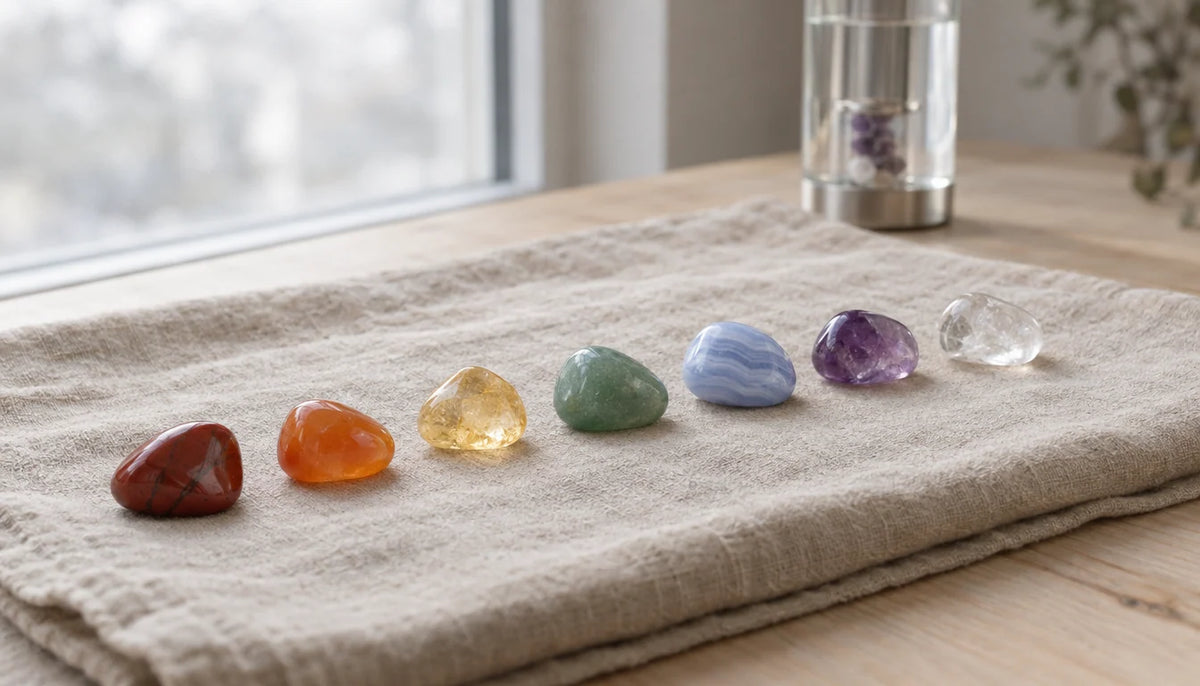
You've got a small rainbow of stones in your hand and you're wondering which one goes where. Chakra stones are crystals that yoga and Hindu traditions pair with the seven chakras. Chakras are energy centers that these traditions say run from the base of the spine to the top of the head.
Here's the short answer. Root gets red jasper or black tourmaline, and sacral gets carnelian. Solar plexus gets citrine, and heart gets rose quartz or green aventurine. Throat gets blue lace agate or sodalite. Third eye gets amethyst, and crown gets clear quartz or selenite.
Below you'll find where each chakra sits, its color and theme, and how people use the stones in a calm daily ritual.
What are the seven chakras, and where do they come from?
The seven chakras come from Indian yoga and Hindu traditions. In these traditions, a chakra is an energy center in the body. A crystal is a natural mineral whose tiny parts line up in a neat, repeating pattern.
Wikipedia's entry on chakras says chakras as energy centers show up in medieval Hindu and Buddhist texts. The older Upanishads, which are early Hindu holy books, talk about breath channels called nadis. They don't lay out chakras. The count also changes from text to text. Some Buddhist texts from the 700s name four or five, and Hindu sources use other numbers.
The best-known set of seven comes from a 1919 book by Arthur Avalon called The Serpent Power. It was a rough translation of a much older text, written in 1577 by Purnananda Yati, about six chakras. Later, Western crystal fans took up the idea and began pairing a stone with each center.
One detail surprises people. Wikipedia dates the rainbow color scheme to the 1930s, long after the old Indian texts were written.
Some readers ask if chakras appear in the Bible. They don't. BibleHub notes that the word isn't in the Bible and that chakras come from old Eastern traditions linked to Hinduism.
One honest note before we go on. The EBSCO Research Starters overview says clinical trials have not shown that crystal healing works. Research has not shown any health effects from chakra stones. So treat everything below as tradition and belief.
Which crystals go with each chakra, and why?
Most chakra crystals are matched by color. The stone's shade echoes the color of its chakra. Here's the walk from root to crown, with each meaning given as tradition holds it.
The root chakra is called Muladhara in Sanskrit, the old language of Hindu texts. It sits at the base of the spine and is red. wikiHow's chakra colors and meanings page links it with safety and feeling grounded. Red jasper matches the color. Black tourmaline gets picked because crystal lore calls it a stone of protection.
Sacral sits in the lower belly and is orange. Its theme is creativity and feeling. Carnelian, an orange stone, is the classic match.
Solar plexus sits in the upper belly and is yellow. It's tied to confidence and willpower. Citrine fits here. It's a yellow kind of quartz, one of the most common minerals on Earth.
Heart sits in the middle of the chest and is green. The same wikiHow page links it with love and kindness. Green aventurine matches the color. Rose quartz is chosen for its soft, loving reputation, even though it's pink.
Throat sits at the throat and is blue. It's linked with speaking up and honesty. Blue lace agate and sodalite are common picks, and lapis lazuli shows up too.
Third eye sits between the brows and is indigo, a deep blue-purple. It's tied to gut feeling and insight. Amethyst, a purple quartz, is the usual stone.
Crown is called Sahasrara in Sanskrit and sits at the top of the head. It's violet or white. People link it with a sense of connection and meaning. Clear quartz and selenite suit its pale, bright color.
Chakra stone chart at a glance
This chart follows the rainbow order that Yahoo Lifestyle's chakra colors article describes, from red at the root to violet at the crown. Keep it handy when you sort a new set.
| Chakra | Location | Color | Stones |
|---|---|---|---|
| Root | Base of the spine | Red | Red jasper, black tourmaline |
| Sacral | Lower belly | Orange | Carnelian |
| Solar plexus | Upper belly | Yellow | Citrine |
| Heart | Center of the chest | Green | Rose quartz, green aventurine |
| Throat | Throat | Blue | Blue lace agate, sodalite |
| Third eye | Between the brows | Indigo | Amethyst |
| Crown | Top of the head | Violet or white | Clear quartz, selenite |
How do people use chakra stones day to day?

Most people use chakra stones in one of three ways. They lie down with them, keep them on display, or hold one while they meditate. EBSCO's research overview on crystal healing notes that in Ayurveda, an old Indian healing tradition, crystals are said to work with a person's aura and seven chakras.
Some people lie down and set one stone on or near each chakra spot while they rest quietly. Others line up all seven on a shelf or desk in rainbow order.
Holding a single stone while you meditate is common too. People also carry pocket stones, wear crystal jewelry, or keep a worry stone. That's a smooth, flat stone you rub with your thumb.
Sets come raw, tumbled smooth, or cut into wands. Pick whatever feels good in your hand.
Many people say the ritual makes them feel calm or more focused. Those are personal feelings and beliefs, and both believers and skeptics are welcome here.
How do you start with one stone and one intention?
Start small. Pick one stone and one intention, and give it a few minutes a day. An intention is a short goal you want to keep in mind. Choose the chakra theme that fits your week, like feeling grounded for root or speaking honestly for throat.
- Hold the stone in your open hand.
- Breathe slowly for a few breaths.
- Say your intention, out loud or in your head.
- Put the stone where you'll see it during the day.
You don't need all seven stones on day one. When you're ready, try a root-to-crown routine. Use one stone per chakra and spend one day on each.
Short and steady beats long and rare. A paper in PubMed Central reports that tying a short practice to something you already do, like brushing your teeth, can help you stick with it. It adds that even five minutes can work. The Greater Good Science Center's article on meditation length describes a two-week study of college students. The group that meditated for 10 minutes kept it up more often than the 20-minute group, and both felt about the same drop in stress.
Missing a day now and then is fine. A study in the Mindfulness journal tracked 96 people and found that skipping an odd day didn't stop a habit from forming.
How do you care for chakra stones?

Store soft stones away from hard ones, and clean most stones gently. The Mohs scale ranks minerals from 1 to 10 by which one can scratch which, as the National Park Service's Mohs hardness scale page explains.
Quartz sits at 7. Selenite is a form of gypsum and sits at only 2, so it scratches easily. Encyclopaedia Britannica points out that the steps aren't even, so going up one number isn't always the same jump.
Keep selenite dry. Wipe it with a soft, dry cloth instead of washing it.
For most other stones, the Gemological Institute of America says warm soapy water and a soft brush is the safest way to clean them. Check each stone first, since a few, like selenite, don't do well in water.
Where Gemstone Well fits
If you'd like a stone ritual that fits into your busy day, a crystal water bottle is one easy option. Gemstone Well bottles keep the stones in a separate chamber, so the stones never touch the water.
That suits someone who sips water all day and wants a stone close by as a reminder of their intention. You can browse bottles grouped by theme, such as Balance or Protection, in the Shop by Energy collection.
Bottom line
The seven chakras come from yoga and Hindu traditions. Each one has its own place, color and theme. Chakra stones are paired with them by tradition, mostly by color. Enjoy them as a belief and a ritual. One stone, one intention and a small daily habit is a good place to begin.
FAQ
Where do you place chakra stones?
Many people lie down and set one stone on or near each chakra spot, from the base of the spine to the top of the head. Others keep a set on a shelf or hold one while they meditate.
What are the seven chakra crystals?
Common picks are red jasper or black tourmaline for root, carnelian for sacral and citrine for solar plexus. Heart gets rose quartz or green aventurine, and throat gets blue lace agate or sodalite. Third eye gets amethyst, and crown gets clear quartz or selenite.
Do I need all seven stones to start?
No. You can start with one stone and one intention for a few minutes a day. Later, you can work from root to crown, one chakra a day.
How do I clean chakra stones?
Warm soapy water and a soft brush work for most stones. Keep soft selenite dry and wipe it with a cloth instead.
Are the 7 chakras in the Bible?
No. BibleHub notes that the word chakra isn't in the Bible, and that chakras come from old Eastern traditions linked to Hinduism.

The Gemstone Well team writes about crystal water bottles, gemstone meanings and simple daily rituals. About us